Turning a spreadsheet-and-email ESG audit into one platform, from zero to MVP in 16 weeks
- Company
- Brillio for Impakt IQ
- Platform
- Web · B2B SaaS
- Timeline
- 4 months (2024)
- Role
- Lead product designer
The problem
Impakt IQ helps companies measure and report their sustainability impact. Every audit ran on email, spreadsheets and third-party forms. Onboarding a client took about three weeks, analysts chased KPI owners by hand, and nobody could see where an audit stood. The firm needed one product that could onboard companies, map ESG KPIs, collect answers and feed reports, and it needed an MVP inside a fixed four-month contract.
My role
Sole designer. Led discovery, IA, interaction and visual design, and the design system through to dev handoff.
Team
1 business analyst, 6 engineers across front end, back end and infra, client stakeholders from Impakt IQ.
Scope
Onboarding, KPI mapping, questionnaires, audit tracking and role-based access for 5 user types.
Design approach grounded in my Interaction Design training at the National Institute of Design (NID).
What moved
What changed for users
Before
- Client details, SOWs and contracts traded over email
- KPI mapping matrix rebuilt in Excel for every audit
- Account executives chased KPI owners one by one
- No shared view of audit progress
After
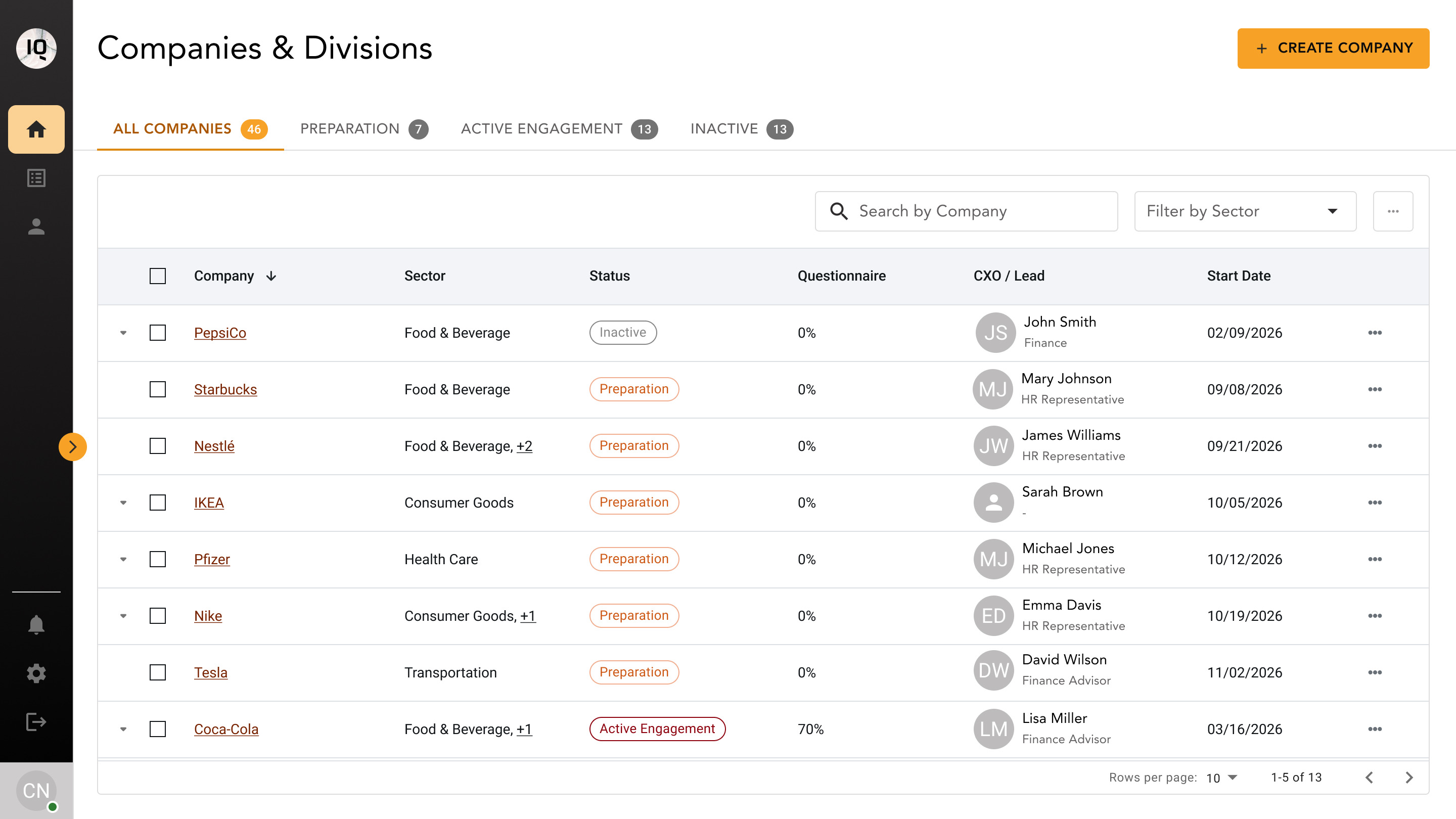
- Guided onboarding creates the company, divisions and CXO login in one flow
- Reusable KPI matrix by sector, industry and framework
- Owners assigned per KPI, with automatic reminders
- Live work plan with per-division progress
The calls that shaped it
Designed around roles, not screens
An RBAC exercise with the BA mapped 5 roles and the permissions each needs. Because one person often holds two roles, I added a role switcher instead of separate logins, which removed an entire support category before launch.
Made the KPI matrix the product's spine
Every later step, from assignment to scoring, reads from the matrix. Making it reusable by sector cut a typical setup from 2 days to under 3 hours.
Shipped on Material, tuned to the brand
I compared Material, Ant, Fluent, Carbon and Lightning against the engineers' component library. Material with a warm brand palette let the team ship 60+ dev-ready screens without a single design-blocked sprint.
Re-scoped the work plan to what could ship
The first concept paired a list with a Gantt chart that the front-end library couldn't support. I reworked it into a progress list with milestone chips, kept the information and saved an estimated 3 sprints.
What I took away
The fastest way through a 0→1 project with a fixed deadline was to agree early on what the MVP would leave out. Reports stayed outside the product for v1, which kept the team focused on the part of the workflow that cost the client the most time.Chayananda Nagesh · Lead product designer
Let's build something people finish using.
I'm looking for senior and lead product design roles on complex enterprise and AI products. Based in Bengaluru, open to hybrid and remote.
nchayananda@gmail.com
Write to me