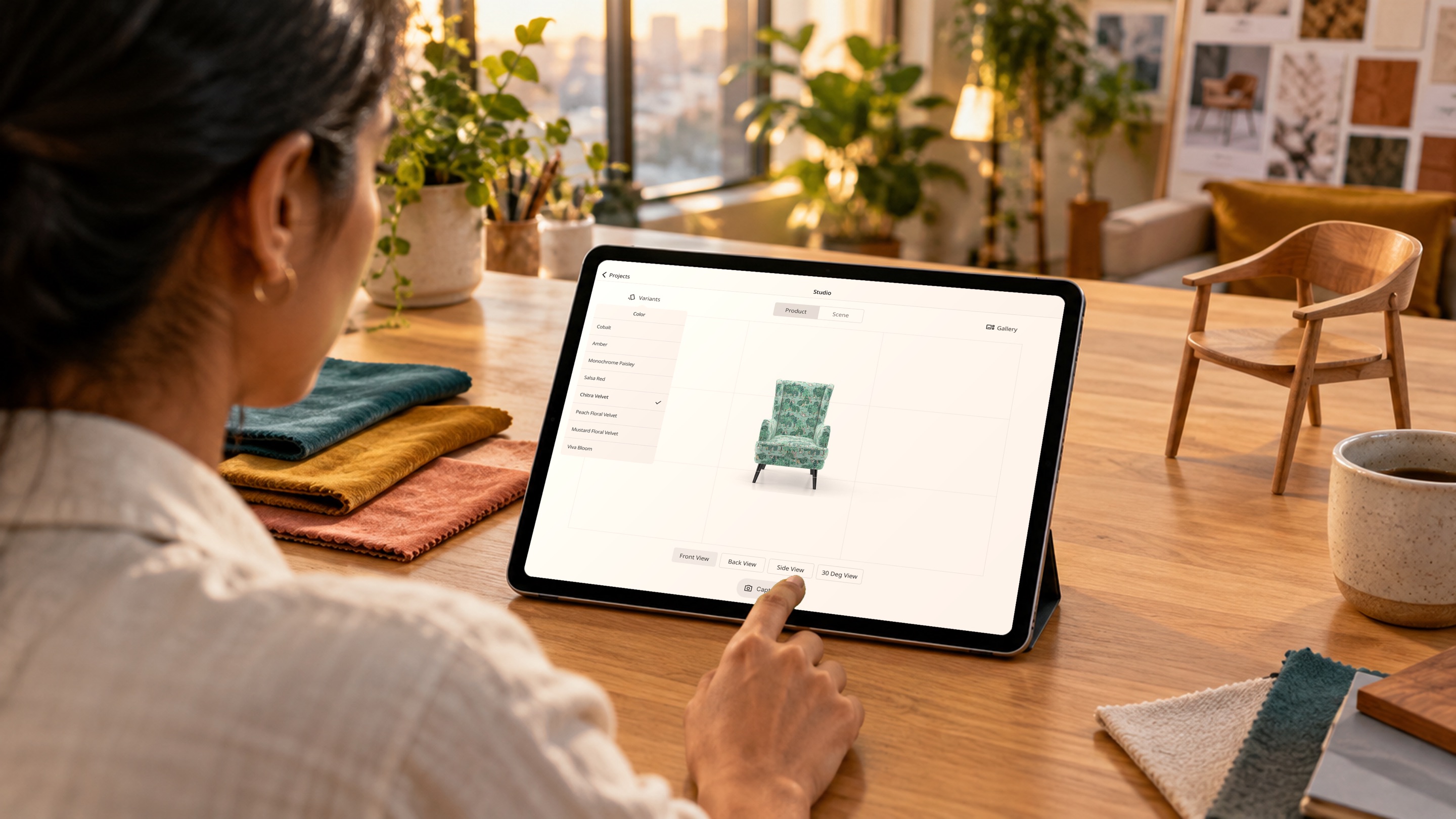
Giving Urban Ladder's art directors a virtual photo studio on iPad to launch products faster
- Company
- Urban Ladder
- Platform
- Tablet · iPadOS
- Timeline
- 6 months
- Role
- UX designer (NID graduation project)
The problem
Product images drive furniture purchases online, and every new Urban Ladder product needed them before launch. Physical shoots meant booking studios, moving furniture and coordinating photographers. 3D renders depended on specialist artists and long feedback loops between eight teams. Image creation had become the slowest step in a product launch.
My role
UX designer, researcher and visual designer. This was my M.Des graduation project at the National Institute of Design.
Team
Reviewed weekly with the VP Product, VP Engineering and the then-CEO. Worked with 3D artists and art directors.
Scope
MVP of Studio (scene setup and shot composition) and Assets (exports, approvals and comments).
Design approach grounded in my Interaction Design training at the National Institute of Design (NID).
What moved
What changed for users
Before
- Physical shoots with studio booking and logistics
- Art directors briefed 3D artists through long email threads
- Files traded between 8 departments with no single source
- Feedback arrived after renders were done
After
- Art directors place products and lights in a virtual studio
- Scene setups saved, edited and exported for rendering
- Searchable asset library tied to each launch
- Comments and approvals on the image itself
The calls that shaped it
Designed for art directors, not 3D artists
Pro tools like Maya and 3ds Max expose hundreds of controls. I limited the studio to camera, lights, material and placement, and used photography language instead of 3D terms, so art directors could work without training.
Prototyped 3D interaction with real users
Sketch couldn't prototype 3D, so I tested gestures in Set A Light Studio and recorded art directors moving cameras and lights. That fixed the orbit, pan and drop-in gestures before engineering started.
Moved steps to the back end
Leadership reviews pushed for automation. Rendering, file naming and versioning happen on the server, which cut the flow from 11 steps to 6.
What I took away
Working with a CEO who reviewed every week taught me to bring decisions, not options. The project also set the approach I still use from NID: understand the whole system before designing any single screen.Chayananda Nagesh · UX designer (NID graduation project)
Let's build something people finish using.
I'm looking for senior and lead product design roles on complex enterprise and AI products. Based in Bengaluru, open to hybrid and remote.
nchayananda@gmail.com
Write to me